
Politics
FRENCH MFA JEAN NOEL BARROT CALLS FOR RESISTANCE TO A BRUTALIZED WORLD ORDER
31st AMBASSADORS CONFRENCE CLOSING
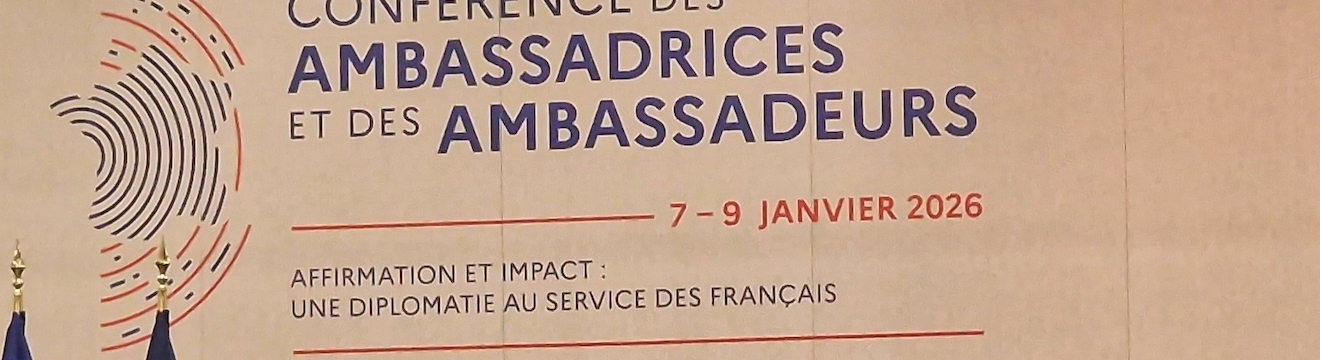
31st Ambassador conference, French Ministry Foreig (Source: Rahma Sophia Rachdi, Jedi Foster)
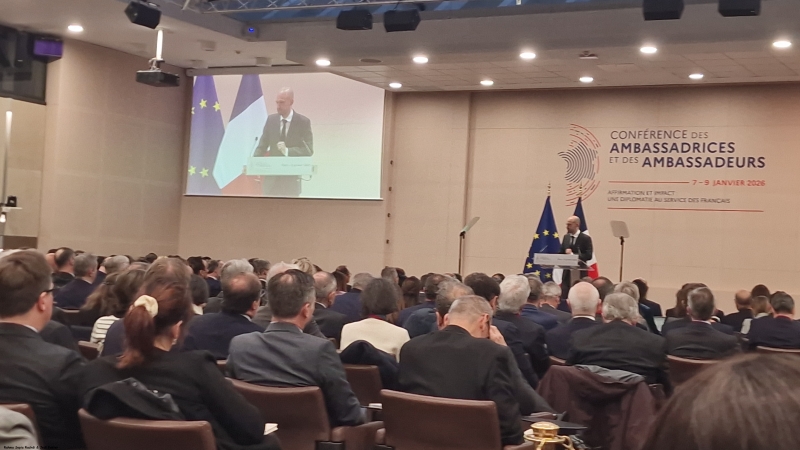
French MFA Jean Noel Barrot
(Source: Rahma Sophia rachdi Jedi Foster)
(Source: Rahma Sophia rachdi Jedi Foster)
France’s foreign minister Jean-Noel Barrot warns of geopolitical tipping point as he used his address to the 2026th annual (31st) Conference of Ambassadors on 9 January 2026 to sketch an ambitious, activist vision for French diplomacy in a world he describes as entering an age of “brutalization.” Speaking before ministers, senior officials and ambassadors at the Ministry, Paris 15th Gutenberg, he framed the current period as a double upheaval: the rapid rise of new powers seeking “revenge” on the West and a profound technological shock that fragments societies and undermines democracies’ ability to build a shared narrative. In his address to France’s ambassadors, the French foreign minister Barrot, describes a world in ‘full geopolitical and cognitive shift’, driven by the rise of new powers and the disruptive impact of technology, and A.I …(Source: Rahma Rachdi’s report on site French MFA Speech, Ministry, Paris 15th Gutenberg)
RETHINGKING THE ALLIANCE WITH UNUITED
The French foreign minister explains that the new US administration has chosen to ‘rethink the ties that bind us’, and asserts France’s right to say no to an ally ‘however historic’ when its proposals are not acceptable.
Against this backdrop, minister Jean-Noël Barrot argued that France and Europe must resist both resignation and the temptation to abandon their own principles, instead reaffirming international law, rebuilding multilateral institutions and projecting a distinctive French voice on global crises, from Ukraine and Gaza to economic security and the information war (Source: French MFA Speech, Ministry, Paris 15th Gutenberg)
The French foreign minister explains that the new US administration has chosen to ‘rethink the ties that bind us’, and asserts France’s right to say no to an ally ‘however historic’ when its proposals are not acceptable.
Against this backdrop, minister Jean-Noël Barrot argued that France and Europe must resist both resignation and the temptation to abandon their own principles, instead reaffirming international law, rebuilding multilateral institutions and projecting a distinctive French voice on global crises, from Ukraine and Gaza to economic security and the information war (Source: French MFA Speech, Ministry, Paris 15th Gutenberg)
A WORLD IN “BRUTALISATION” AND THE AMERICAN SHOCK
French Minster of Foreign Affairs, Jean-Noël Barrot denounces the ‘brutalisation’ of international law from Sudan to Gaza and Ukraine, warns of renewed nuclear proliferation risks, including Iran’s program, and insists that the only valid response is resistance, not resignation or abandonment of France’s universalist
Jean Noel Barrot, French MFA, (French and Swiss citizen) situates French diplomacy in what he calls a “geopolitical and cognitive tipping point,” marked by the acceleration of emerging powers and the intrusive spread of technology into everyday life. He notes that, for many countries, economic catch up feels like a form of revenge on the West, fueling a relentless quest for power, wealth and expansion, while digital technologies atomize social relations, flatten public debate and threaten democracies’ capacity to construct a common story.
French Minster of Foreign Affairs, Jean-Noël Barrot denounces the ‘brutalisation’ of international law from Sudan to Gaza and Ukraine, warns of renewed nuclear proliferation risks, including Iran’s program, and insists that the only valid response is resistance, not resignation or abandonment of France’s universalist
Jean Noel Barrot, French MFA, (French and Swiss citizen) situates French diplomacy in what he calls a “geopolitical and cognitive tipping point,” marked by the acceleration of emerging powers and the intrusive spread of technology into everyday life. He notes that, for many countries, economic catch up feels like a form of revenge on the West, fueling a relentless quest for power, wealth and expansion, while digital technologies atomize social relations, flatten public debate and threaten democracies’ capacity to construct a common story.
RESISTING “BRUTALIZATION” & DEFENDING INTERNATIONAL LAW
As we are Facing the ‘Brutalization’ of International Law and Security, the most striking development at the start of 2026, Minister Barrot argues, comes from France’s main ally, the United States, whose new administration has decided to “rethink” transatlantic ties, prompting Paris to assert that it has both the right and the duty to say no when an ally’s proposals are not acceptable. Without naming Donald Trump, the speech clearly echoes the style of Trump’s second presidency and its tariff threats, unilateral security moves and transactional bargaining posture, which Minister J.N Barrot implicitly contrasts with a more traditional, rules based Western leadership.
As we are Facing the ‘Brutalization’ of International Law and Security, the most striking development at the start of 2026, Minister Barrot argues, comes from France’s main ally, the United States, whose new administration has decided to “rethink” transatlantic ties, prompting Paris to assert that it has both the right and the duty to say no when an ally’s proposals are not acceptable. Without naming Donald Trump, the speech clearly echoes the style of Trump’s second presidency and its tariff threats, unilateral security moves and transactional bargaining posture, which Minister J.N Barrot implicitly contrasts with a more traditional, rules based Western leadership.
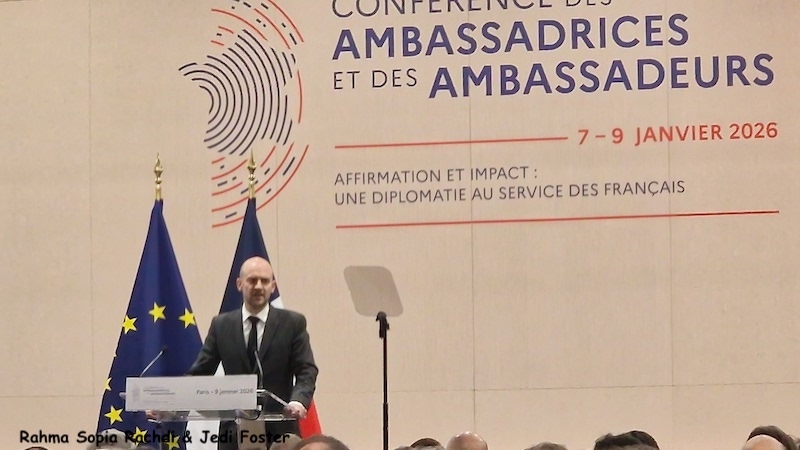
French MFA Jean Noel Barrot
Source: Rahma Sophia Rachdi, Jedi Foster
Source: Rahma Sophia Rachdi, Jedi Foster
RESISTING RESIGNATION & DEFENDING INTERNAYIONAL LAW
The core conceptual thread of the address is “brutalization”: the erosion of law, norms and restraints across multiple domains. Minister J.N Barrot lists the brutalization of international law, citing Sudan, the Great Lakes region, Gaza and Ukraine as places where millions of civilians’ face death or exile while permanent members of the UN Security Council themselves violate the order they were meant to guard. He points to the looming expiry of New START and the next Non Proliferation Treaty review conference as symbols of an international stability architecture in crisis, warning that nuclear proliferation risks are returning and that only a negotiated solution can end “Iran’s nuclear program” even as some nuclear armed powers brandish deterrence as a cover for “colonial-style aggression.”
The core conceptual thread of the address is “brutalization”: the erosion of law, norms and restraints across multiple domains. Minister J.N Barrot lists the brutalization of international law, citing Sudan, the Great Lakes region, Gaza and Ukraine as places where millions of civilians’ face death or exile while permanent members of the UN Security Council themselves violate the order they were meant to guard. He points to the looming expiry of New START and the next Non Proliferation Treaty review conference as symbols of an international stability architecture in crisis, warning that nuclear proliferation risks are returning and that only a negotiated solution can end “Iran’s nuclear program” even as some nuclear armed powers brandish deterrence as a cover for “colonial-style aggression.”
Notably, Iran appears only in this limited, technical way mentioned three times in relation to its nuclear program despite the fact that at the time of his speech the country was in the grip of a new revolutionary wave and a near total internet blackout, with protesters in the streets calling for the end of Supreme Leader Ali Khamenei’s rule and invoking the Shah’s son as an alternative. Minister J.N Barrot warns against two temptations: passive lamentation in the face of violence, and cynical abandonment of France’s own universalist tradition, quoting René Cassin to insist that “the peoples of the world must remain the recipients of our message,” anchored in liberty, equality, fraternity, dignity, democracy, science and education.
EUROPE’S ROLE, GLOBAL SOUTH NARRATIVE & LIMITED IRAN FOCUS
From this diagnosis, Minister J.N Barrot derives three “principles” for resisting brutalization: domination is ultimately self defeating, there is no monolithic “global South” or unified “collective West,” and international law is not dead even if its institutions are in crisis. He rejects the notion of a coherent global South arrayed against an undifferentiated West, calling such categories “political constructs designed by our adversaries,” and argues instead that the real dividing line separates those who support rule based multilateralism from those who do not.
From this diagnosis, Minister J.N Barrot derives three “principles” for resisting brutalization: domination is ultimately self defeating, there is no monolithic “global South” or unified “collective West,” and international law is not dead even if its institutions are in crisis. He rejects the notion of a coherent global South arrayed against an undifferentiated West, calling such categories “political constructs designed by our adversaries,” and argues instead that the real dividing line separates those who support rule based multilateralism from those who do not.
EUROPE, THE SO-CALLED GLOBAL SOUTH & FRAGMENTED ORDER
The French foreign minister Barrot, rejects narratives of a monolithic ‘global South’ and a unified ‘collective West’, arguing instead that the real divide is between supporters and opponents of rule based multilateralism, and calling for a reformed UN Security Council with new African permanent France’s answer, he says, is to use its G7 presidency to confront structural imbalances Chinese over production, European under investment, American over indebtedness and under development in the poorest countries and to deepen dialogue with key emerging powers such as India, which chairs the BRICS and whose foreign minister is guest of honor at the conference.
The French foreign minister Barrot, rejects narratives of a monolithic ‘global South’ and a unified ‘collective West’, arguing instead that the real divide is between supporters and opponents of rule based multilateralism, and calling for a reformed UN Security Council with new African permanent France’s answer, he says, is to use its G7 presidency to confront structural imbalances Chinese over production, European under investment, American over indebtedness and under development in the poorest countries and to deepen dialogue with key emerging powers such as India, which chairs the BRICS and whose foreign minister is guest of honor at the conference.
EUROPE’S ROLE IN A FRAGMENTED WORLD BEYOND GLOBAL SOUTH Vs WEST
Minister Barrot also calls for reform of the UN Security Council, including adding two permanent African members, and insists that Europe is not on the verge of “civilizational disappearance” but must nevertheless defend its borders and interests against Russian coercion, unfair economic competition and terrorism. In that context, Iran appears again only as part of a triad of threats “the Kremlin, the Iranian nuclear program and Islamist terrorism” underscoring how limited a place the Islamic Republic occupies in Jean Noel Barrot’s narrative even as events inside Iran are unfolding with historic intensity.
Minister Barrot also calls for reform of the UN Security Council, including adding two permanent African members, and insists that Europe is not on the verge of “civilizational disappearance” but must nevertheless defend its borders and interests against Russian coercion, unfair economic competition and terrorism. In that context, Iran appears again only as part of a triad of threats “the Kremlin, the Iranian nuclear program and Islamist terrorism” underscoring how limited a place the Islamic Republic occupies in Jean Noel Barrot’s narrative even as events inside Iran are unfolding with historic intensity.
A “CREATIVE” FRENCH DIPLOMACY: RECOGNIZING PALESTINE, COALITIONS & ECONOMIC SECURITY
The second half of the speech shifts from principles to a self portrait of French diplomacy as both “singular” and “creative.” Minister J.N Barrot highlights several “successes,” including France’s role in amending a US drafted UN resolution on Russia’s war in Ukraine, and a major diplomatic push at the UN General Assembly that produced a resolution condemning Hamas, calling for its disarmament, sketching regional integration and affirming Palestinian self determination, adopted by 142 votes to 10.
The second half of the speech shifts from principles to a self portrait of French diplomacy as both “singular” and “creative.” Minister J.N Barrot highlights several “successes,” including France’s role in amending a US drafted UN resolution on Russia’s war in Ukraine, and a major diplomatic push at the UN General Assembly that produced a resolution condemning Hamas, calling for its disarmament, sketching regional integration and affirming Palestinian self determination, adopted by 142 votes to 10.
FROM RECOGNIZING PALESTINE TO BUILDINGG COALISTAIONS & ECONOMIC SOVEREIGNTY
Jean-Noël Barrot highlights France’s ‘singular voice’ in securing a UN resolution on Gaza, recognizing the State of Palestine alongside ten other countries, forming ad hoc coalitions on security and oceans, and creating a new Directorate for Sovereignty and Economic Security to confront geo economic coercions.
Jean-Noël Barrot highlights France’s ‘singular voice’ in securing a UN resolution on Gaza, recognizing the State of Palestine alongside ten other countries, forming ad hoc coalitions on security and oceans, and creating a new Directorate for Sovereignty and Economic Security to confront geo economic coercions.
Building on that basis, he notes, France has recognized the State of Palestine and “brought along ten other countries,” including the United Kingdom, Canada and Australia an initiative that signals a newly assertive French line on the Israeli Palestinian conflict and shows Paris seeking to seize diplomatic momentum at a time of broader global turbulence. Minister J.N Barrot also cites a Paris led coalition of over 30 countries engaged in unprecedented military planning to tackle a European security problem outside NATO, French leadership in securing the high seas treaty and convening a major ocean summit in Nice, and a domestic information warfare effort epitomized by the “French Response” team to counter deepfakes and hostile narratives. Economic security is another key theme: he announces the creation of a Directorate for Sovereignty and Economic Security, endowed with customs powers, tasked with shielding critical supply chains, fighting coercive trade practices and acting as “shield, sword and brain” for France’s geo economic posture in an era of trade wars and weaponized interdependence.
A TURBULENT GEOPOLITICAL MOMENT & RETURN OF FRENCH DIPLOMATIC AMBITION TO “RENEW ITSELF”
Minister J.N Barrot’s closing emphasis on “courage” and “strength of soul” recasts diplomacy as a form of resistance in a “hardened world,” directly linking France’s external posture to domestic resilience and democratic confidence. The broader geopolitical storm Russia’s grinding war in Ukraine, escalation cycles in the Middle East, contested trade regimes, resurgent terrorism and the intensifying US–China rivalry creates both dangers and opportunities for French diplomacy, which had seemed to drift after Donald Trump’s first election shattered established transatlantic routines, imposed punitive tariffs and elevated a more transactional, force centred style of bargaining foreign to traditional Euro Atlantic elites.
Minister J.N Barrot’s closing emphasis on “courage” and “strength of soul” recasts diplomacy as a form of resistance in a “hardened world,” directly linking France’s external posture to domestic resilience and democratic confidence. The broader geopolitical storm Russia’s grinding war in Ukraine, escalation cycles in the Middle East, contested trade regimes, resurgent terrorism and the intensifying US–China rivalry creates both dangers and opportunities for French diplomacy, which had seemed to drift after Donald Trump’s first election shattered established transatlantic routines, imposed punitive tariffs and elevated a more transactional, force centred style of bargaining foreign to traditional Euro Atlantic elites.
FRENCH DIPLOMACY IN A TIME OF DISRUPTION : THE STRENGHT OF SOUL IS TO REVIVING IT IN A HARDENED WORLD
The French foreign minister Barrot closes by calling for ‘strength of soul’ to defend Europe, uphold international law and protect French interests, presenting France as both guardian and innovator of the rules based order in an era of wars, trade conflicts and information battles.
In that sense, the current turmoil “gives wings” to a French diplomacy that had been perceived recently as running on autopilot: faced with a Washington oval office, led by a businessman strategist president, named Donald Trump comfortable with disruption and coercive leverage, Paris is rediscovering its Gaullist reflex of strategic autonomy, using the G7 chair (To be chaired in 2026 by France on 14th June ), UN platforms and European initiatives to carve out space for its own agenda.
The French foreign minister Barrot closes by calling for ‘strength of soul’ to defend Europe, uphold international law and protect French interests, presenting France as both guardian and innovator of the rules based order in an era of wars, trade conflicts and information battles.
In that sense, the current turmoil “gives wings” to a French diplomacy that had been perceived recently as running on autopilot: faced with a Washington oval office, led by a businessman strategist president, named Donald Trump comfortable with disruption and coercive leverage, Paris is rediscovering its Gaullist reflex of strategic autonomy, using the G7 chair (To be chaired in 2026 by France on 14th June ), UN platforms and European initiatives to carve out space for its own agenda.
Yet the near silence on Iran’s domestic uprising in Jean Noel Barrot’s speech also illustrates the limits of this new activism, revealing how France’s desire to preserve the most ancient diplomatic channels on nuclear and regional security can still outweigh a more vocal alignment with popular movements on the ground in the name of so beloved “ multilateralism” by french President Emmanuel Macron
In the end, Minister JN Barrot’s address sketches a France that wants to be both guardian and innovator of the rules based order recognizing Palestine, reforming the UN, defending Europe’s borders and launching economic security tools while navigating a landscape transformed by POTUS Trump era disruption, reckless assertiveness and societies in revolt from Tehran to Kiev…/ To be continued as the revolutionary Iranien movement is evolving as we publish…(Source: Rahma Rachdi’s report on site French MFA Speech, Ministry, Paris 15th Gutenberg)
Liability for this article lies with the author, who also holds the copyright. Editorial content from USPA may be quoted on other websites as long as the quote comprises no more than 5% of the entire text, is marked as such and the source is named (via hyperlink).