Politics
THE FRENCH PRESIDENT SAYS PARIS WASN'T WARNED NOR CONSULTED ON US/ISRAEL STRIKES
CALLS FOR AN URGENT UN SECURITY COUNCIL
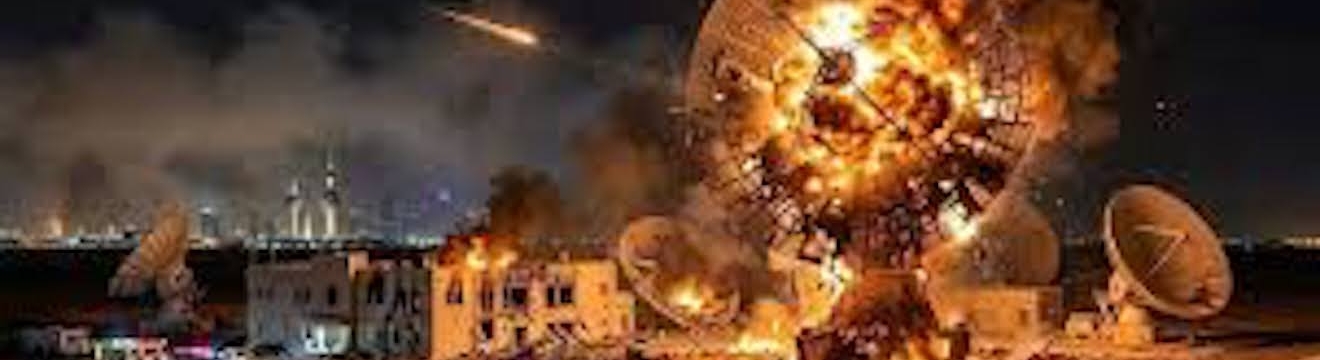
Iran/Israel Strikes (Source: Facebook)
USPA NEWS -
Below, we publish the introductory remarks made by French president Emmanuel Macron at a Defence and National Security Council meeting on the situation in Iran and the wider Middle East, held at the Elysee Palace (French presidency) on 28 February 2026. The text offers a rare, unvarnished glimpse into how France is positioning itself between its American ally, its European partners and a Middle East on the brink, after coordinated strikes by the United States and Israel against Iran and a wave of Iranian reprisals across the region. In a few carefully chosen sentences, Macron insists that “France was neither informed nor involved” in the strikes, sets three clear priorities, the protection of French citizens, the security of French military and diplomatic assets, and the stability of the homeland, and calls for a diplomatic surge at the United Nations to address not only the current escalation but also the underlying nuclear, ballistic and regional issues. For a Europe already worried about war on its eastern flank, these words underline how quickly the Middle East can once again become the epicentre of global crisis management.
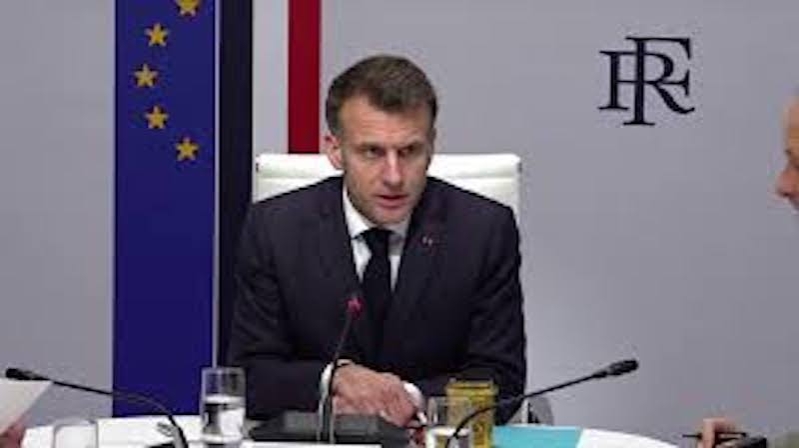
President Macron, Council of Defence, Elysee
Source: French Presidency, Elysee
Source: French Presidency, Elysee
This is an editorial, not on the ground reporting. It reflects the independent analysis of our handy journalist and relies on officially available French information and verified public statements.
IRAN CRISIS: MACRON PUTS FRENCH CITIZENS’ SECURITY AND UN DIPLOMACY AT THE HEART OF PARIS’ RESPONSE
Below, we publish the introductory remarks made by French president Emmanuel Macron at a Defence and National Security Council meeting on the situation in Iran and the wider Middle East, held at the Elysee Palace (French presidency) on 28 February 2026. The text offers a rare, unvarnished glimpse into how France is positioning itself between its American ally, its European partners and a Middle East on the brink, after coordinated strikes by the United States and Israel against Iran and a wave of Iranian reprisals across the region. In a few carefully chosen sentences, Macron insists that “France was neither informed nor involved” in the strikes, sets three clear priorities, the protection of French citizens, the security of French military and diplomatic assets, and the stability of the homeland, and calls for a diplomatic surge at the United Nations to address not only the current escalation but also the underlying nuclear, ballistic and regional issues. For a Europe already worried about war on its eastern flank, these words underline how quickly the Middle East can once again
Below, we publish the introductory remarks made by French president Emmanuel Macron at a Defence and National Security Council meeting on the situation in Iran and the wider Middle East, held at the Elysee Palace (French presidency) on 28 February 2026. The text offers a rare, unvarnished glimpse into how France is positioning itself between its American ally, its European partners and a Middle East on the brink, after coordinated strikes by the United States and Israel against Iran and a wave of Iranian reprisals across the region. In a few carefully chosen sentences, Macron insists that “France was neither informed nor involved” in the strikes, sets three clear priorities, the protection of French citizens, the security of French military and diplomatic assets, and the stability of the homeland, and calls for a diplomatic surge at the United Nations to address not only the current escalation but also the underlying nuclear, ballistic and regional issues. For a Europe already worried about war on its eastern flank, these words underline how quickly the Middle East can once again
“FRANCE WAS NEITHER INFORMED NOR INVOLVED”: A CRISIS ERUPTS OVERNIGHT
In his opening remarks, President Emmanuel Macron begins by setting the tone for a crisis that he describes as both sudden and potentially destabilising for the entire region. He recalls that “The United States of America and Israel have decided to strike Iran in the last few hours. France was neither informed nor involved, just as, moreover, all the countries in the region and our allies were not informed or involved.” By putting this sentence at the very start of his address, Macron sends a double message: Paris was sidelined in the decision making process, and it does not wish to be associated politically or militarily with the strikes carried out by Washington and Jerusalem.
In his opening remarks, President Emmanuel Macron begins by setting the tone for a crisis that he describes as both sudden and potentially destabilising for the entire region. He recalls that “The United States of America and Israel have decided to strike Iran in the last few hours. France was neither informed nor involved, just as, moreover, all the countries in the region and our allies were not informed or involved.” By putting this sentence at the very start of his address, Macron sends a double message: Paris was sidelined in the decision making process, and it does not wish to be associated politically or militarily with the strikes carried out by Washington and Jerusalem.
The French President Macron then underlines the immediate consequences of Iran’s response, which has targeted “a very large number of countries, a very large number of friendly countries where, in many of them, we have military facilities and nationals, with consequences for regional stability, peace in the region and beyond.” Here, the Élysée clearly frames the crisis not as a bilateral showdown between the United States, Israel and Iran, but as a regional shockwave, affecting friendly states where France has soldiers on the ground, diplomatic missions and expatriate communities. For Paris, this means that the escalation is no longer an abstract geopolitical chess game; it is a direct risk to French lives and to the fragile balance of power in the Gulf, the Levant and beyond. Source: Communique of the Presidency of the French Republic, Elysee.
Faced with this deterioration, Macron explains why he has convened the Defence and National Security Council on a Saturday evening: “Thank you very much for being here for this Defence Council, so that we can review both the analysis of the situation, of course, and the necessary actions to be taken, in addition to what has already been done.” The formula shows a France already engaged in protective measures, but determined to reassess both its intelligence picture and its room for manoeuvre as events unfold hour by hour. The presence of the Prime Minister and key ministers underlines that this is not only a foreign policy file but also a domestic security issue.
PROTECTING FRENCH NATIONALS, SUPPORTING REGIONAL ALLIES AND REVIVING DIPLOMACY: MACRON’S THREE STEP RESPONSE TO THE IRAN ESCALATION
President Emmanuel Macron then organises France’s response around three concentric circles of security, starting with the most immediate one: “Our absolute priority is, of course, the security of our nationals in all the countries that are being struck today.” In regions where airspace is contested, critical infrastructure is targeted and missiles or drones can be launched with little warning, the protection and possible evacuation of nationals becomes the first duty of the state. This is consistent with France’s traditional doctrine in crisis zones, from Lebanon to the Sahel: citizens first, then assets, then broader diplomatic considerations.
President Emmanuel Macron then organises France’s response around three concentric circles of security, starting with the most immediate one: “Our absolute priority is, of course, the security of our nationals in all the countries that are being struck today.” In regions where airspace is contested, critical infrastructure is targeted and missiles or drones can be launched with little warning, the protection and possible evacuation of nationals becomes the first duty of the state. This is consistent with France’s traditional doctrine in crisis zones, from Lebanon to the Sahel: citizens first, then assets, then broader diplomatic considerations.
The second circle concerns the protection of French facilities abroad: “Next comes the security of our military and diplomatic facilities in all of these countries and in those that could be exposed.” Here, President Macron hints at a broad map of French deployments, from bases in the Gulf and the Indian Ocean to embassies and consulates located in countries now exposed to Iranian retaliation or to spillover attacks by proxy groups. The language suggests that France is reviewing force protection measures, raising security postures and coordinating with host governments and allies to prevent its troops and diplomats from becoming collateral victims of the confrontation.
Finally, the head of state brings the focus back home: “And of course it is also about security on our own national territory; we will have the opportunity to return to this.” With this short sentence, President Emmanuel Macron points to the risk of imported tensions, cyberattacks, disinformation operations or even terrorist threats on French soil, at a time when domestic debates on the Middle East are already highly polarised. The implicit message is that what happens between Tehran, Washington and Jerusalem can also reverberate in Paris, Lyon or Marseille, not only in strategic circles but in streets, places of worship and public debate. Source: Communique of the Presidency of the French Republic, Elysee
“GIVING DIPLOMACY BACK ITS ROLE”: UN DIPLOMACY, NUCLEAR RISKS AND THE VOICE OF THE IRANIAN PEOPLE
Beyond emergency management, President Macron insists on the need to relaunch diplomacy rather than accept a drift towards open regional war. He explains that France must “take all useful initiatives so that diplomatic work can regain its full role.” For him, the core of this effort is multilateral: “We have already called for an extraordinary meeting of the United Nations Security Council, and we must multiply initiatives so that this issue is resolved through diplomatic means.” The message is aimed both at allies and at adversaries: there is, in Paris’ view, no sustainable solution to the Iranian file nuclear, ballistic or regional that can be obtained by strikes alone.
Beyond emergency management, President Macron insists on the need to relaunch diplomacy rather than accept a drift towards open regional war. He explains that France must “take all useful initiatives so that diplomatic work can regain its full role.” For him, the core of this effort is multilateral: “We have already called for an extraordinary meeting of the United Nations Security Council, and we must multiply initiatives so that this issue is resolved through diplomatic means.” The message is aimed both at allies and at adversaries: there is, in Paris’ view, no sustainable solution to the Iranian file nuclear, ballistic or regional that can be obtained by strikes alone.
President Emmanuel Macron explicitly lists the issues that cannot be “settled simply by strikes”: “No one can think that the question of Iran’s nuclear programme, its ballistic activities and regional destabilisation will be resolved simply by airstrikes.” This is a reminder of how broad and complex the Iranian dossier has become. It encompasses the future of the 2015 nuclear agreement, Iran’s missile and drone programme, and the network of allied militias and partners that Tehran supports in Iraq, Syria, Lebanon, Yemen and elsewhere. By bundling these elements together, the French president signals that any serious negotiation will have to go far beyond crisis de escalation and cover the deeper architecture of regional security.
Finally, President Macron connects the international crisis to the internal situation in Iran and to the protests that have shaken the country in recent months. He recalls “the legitimate rights of the Iranian people to make their voices heard, which they have asserted again in recent months while being terribly repressed; their right is to decide their own destiny. And this is also one of the things we must do everything we can to defend.” In doing so, he positions France not only as a power concerned with nuclear risks and regional stability, but also as a state that claims to support the aspirations of Iranian citizens, especially women and young people, who have paid a high price for demanding economic justice, political freedoms and respect for fundamental rights. Source: Communiqué of the Presidency of the French Republic.
As the investigation advances and official information continues to emerge, we will keep following this case closely and return to it in future articles, both to reflect the facts as they are established and to analyse what they reveal about France’s political climate in the run up to the March 2026 municipal elections and the April 2027 presidential race.
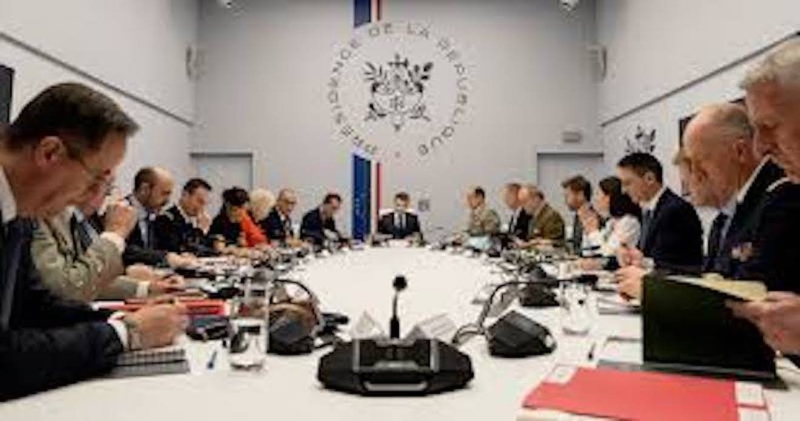
Frenhc Council of Defense & Security, Elysee
Source: French Presidency, Elysee
Source: French Presidency, Elysee
Liability for this article lies with the author, who also holds the copyright. Editorial content from USPA may be quoted on other websites as long as the quote comprises no more than 5% of the entire text, is marked as such and the source is named (via hyperlink).