Politics
G7, UN & FRANCE UNDER PRESSURE FROM A “MAJOR HUMANITARIAN EMERGENCY”
TO A LAST CHANCE FOR DE ESCALATION
Logo G7, Summit, Evian 2026 (Source: G7 France 2026)
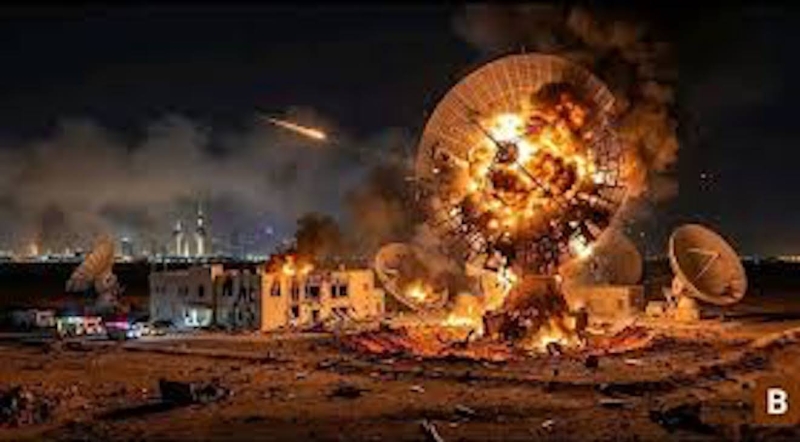
Iran War Strikes
(Source: Facebook)
(Source: Facebook)
This is an editorial geopolitical analysis, not an on the ground report, based on UN and humanitarian data, open diplomatic sources and my own observations as a Paris based correspondent. After one week of US–Israeli strikes and Iranian retaliation, the human cost is already shocking: estimates compiled from local health authorities and humanitarian monitors suggest that at least several hundred people have been killed in Iran, many reports point to a toll in the range of 500–600 dead, and well over a thousand injured, as missiles and bombs hit military sites and populated areas. The United Nations and the International Red Cross movement warn that these figures are likely to rise as access improves and that many of the wounded cannot yet be reached safely, with hospitals struggling under power cuts, damage to infrastructure and shortages of critical supplies.
This is an editorial geopolitical analysis, not an on the ground report, based on official statements and the author’s own experience as a Paris based correspondent watching this crisis unfold almost in real time.
ONE WEEK OF WAR IN IRAN: A HUMANITARIAN MAP IN FLAMES
This is an editorial geopolitical analysis, not an on the ground report, based on UN and humanitarian data, open diplomatic sources and my own observations as a Paris based correspondent. After one week of US–Israeli strikes and Iranian retaliation, the human cost is already shocking: estimates compiled from local health authorities and humanitarian monitors suggest that at least several hundred people have been killed in Iran, many reports point to a toll in the range of 500–600 dead, and well over a thousand injured, as missiles and bombs hit military sites and populated areas. The United Nations and the International Red Cross movement warn that these figures are likely to rise as access improves and that many of the wounded cannot yet be reached safely, with hospitals struggling under power cuts, damage to infrastructure and shortages of critical supplies.
This is an editorial geopolitical analysis, not an on the ground report, based on UN and humanitarian data, open diplomatic sources and my own observations as a Paris based correspondent. After one week of US–Israeli strikes and Iranian retaliation, the human cost is already shocking: estimates compiled from local health authorities and humanitarian monitors suggest that at least several hundred people have been killed in Iran, many reports point to a toll in the range of 500–600 dead, and well over a thousand injured, as missiles and bombs hit military sites and populated areas. The United Nations and the International Red Cross movement warn that these figures are likely to rise as access improves and that many of the wounded cannot yet be reached safely, with hospitals struggling under power cuts, damage to infrastructure and shortages of critical supplies.
THOUSANDS OF CASUALTIES, HUNDREDS OF THOUSANDS DISPLACED, AND A FRENCH G7 PRESIDENCY UNDER PRESSURE
Beyond Iran, the humanitarian picture is even more dramatic. In Lebanon, Israeli evacuation orders, cross border fire and sustained strikes against Hezbollah positions have forced tens of thousands of people to flee the south and the southern suburbs of Beirut; UNHCR reports that at least around 30,000 displaced people are already crowded into formal shelters, while agencies such as the Norwegian Refugee Council estimate that some 300,000 Lebanese have had to leave their homes since the latest round of fighting began. The UN refugee agency now describes the wider Middle East as a “major humanitarian emergency”, and the Red Cross and Red Crescent networks are scaling up operations on both sides of the border, focusing on emergency medical care, evacuation of the most vulnerable and restoring basic services like water, electricity and communications to communities cut off by the fighting.
Beyond Iran, the humanitarian picture is even more dramatic. In Lebanon, Israeli evacuation orders, cross border fire and sustained strikes against Hezbollah positions have forced tens of thousands of people to flee the south and the southern suburbs of Beirut; UNHCR reports that at least around 30,000 displaced people are already crowded into formal shelters, while agencies such as the Norwegian Refugee Council estimate that some 300,000 Lebanese have had to leave their homes since the latest round of fighting began. The UN refugee agency now describes the wider Middle East as a “major humanitarian emergency”, and the Red Cross and Red Crescent networks are scaling up operations on both sides of the border, focusing on emergency medical care, evacuation of the most vulnerable and restoring basic services like water, electricity and communications to communities cut off by the fighting.
UN SECURITY COUNCIL: A DIVIDED ROOM, RISING BODIES
At the United Nations, the Security Council met in emergency session as soon as the strikes on Iran began, but its divisions have been as visible as its concern. The Secretary General and the UN human rights chief have condemned attacks by all parties and reminded states that they must respect international humanitarian law, warning that deliberate or reckless strikes on civilian areas and infrastructure could amount to war crimes. Iran has denounced the US and Israel for what it calls aggression and collective punishment, while Washington insists it is acting in self defence and several Western members call on Tehran to halt missile and drone attacks on their forces and allies. So far, competing draft resolutions and veto threats have prevented the Council from adopting a binding text, even as casualty numbers on the ground continue to climb.
At the United Nations, the Security Council met in emergency session as soon as the strikes on Iran began, but its divisions have been as visible as its concern. The Secretary General and the UN human rights chief have condemned attacks by all parties and reminded states that they must respect international humanitarian law, warning that deliberate or reckless strikes on civilian areas and infrastructure could amount to war crimes. Iran has denounced the US and Israel for what it calls aggression and collective punishment, while Washington insists it is acting in self defence and several Western members call on Tehran to halt missile and drone attacks on their forces and allies. So far, competing draft resolutions and veto threats have prevented the Council from adopting a binding text, even as casualty numbers on the ground continue to climb.
G7 AT EVIAN: A PEACE AGENDA BLOWN APART
For the G7, the timing could hardly be worse. Under France’s presidency, the 2026 summit in Evian les Bains was supposed to focus on long term issues such as climate, economic resilience and digital regulation, A.I governance; instead, it is now overshadowed by a war that directly involves one G7 member, the United States, and places others under pressure to choose sides.
Previous G7 statements had already described Iran as a source of regional instability and stressed that Tehran must never acquire nuclear weapons, but the scale of the latest strikes forces leaders to confront a more urgent question: how to stop a conflict that is already devastating parts of Iran and Lebanon from spilling into a wider regional – or even global war. France, as G7 host, is trying to hold a common line that combines solidarity with affected allies, defence of international law and a renewed focus on humanitarian access, in particular in Lebanon, where the UN Interim Force (UNIFIL) has been deployed in the south since 1978 with its headquarters in Naqoura and a long standing French contingent among its battalions.
For the G7, the timing could hardly be worse. Under France’s presidency, the 2026 summit in Evian les Bains was supposed to focus on long term issues such as climate, economic resilience and digital regulation, A.I governance; instead, it is now overshadowed by a war that directly involves one G7 member, the United States, and places others under pressure to choose sides.
Previous G7 statements had already described Iran as a source of regional instability and stressed that Tehran must never acquire nuclear weapons, but the scale of the latest strikes forces leaders to confront a more urgent question: how to stop a conflict that is already devastating parts of Iran and Lebanon from spilling into a wider regional – or even global war. France, as G7 host, is trying to hold a common line that combines solidarity with affected allies, defence of international law and a renewed focus on humanitarian access, in particular in Lebanon, where the UN Interim Force (UNIFIL) has been deployed in the south since 1978 with its headquarters in Naqoura and a long standing French contingent among its battalions.
FRANCE, UNIFIL AND A LONG COMMITMENT TO SOUTHERN LEBANON
French Presidency likes to remind partners that it was one of the first contributors to UNIFIL, that it still provides troops, trainers and demining experts in support of the Lebanese Armed Forces, and that it sponsored the latest UN resolution renewing the mission’s mandate through the end of 2026. President Emmanuel Macron himself has made Lebanon a personal test case: since his election in 2017 he has travelled there several times, including two highly symbolic visits in the days and weeks following the Beirut port explosion in August 2020 and a more recent trip in early 2025 as a ceasefire between Israel and Hezbollah was taking hold. Each time he has presented France as a guarantor of Lebanon’s stability and as a broker of “durable peace” in a country he sees as both fragile and central to the balance of the region.
French Presidency likes to remind partners that it was one of the first contributors to UNIFIL, that it still provides troops, trainers and demining experts in support of the Lebanese Armed Forces, and that it sponsored the latest UN resolution renewing the mission’s mandate through the end of 2026. President Emmanuel Macron himself has made Lebanon a personal test case: since his election in 2017 he has travelled there several times, including two highly symbolic visits in the days and weeks following the Beirut port explosion in August 2020 and a more recent trip in early 2025 as a ceasefire between Israel and Hezbollah was taking hold. Each time he has presented France as a guarantor of Lebanon’s stability and as a broker of “durable peace” in a country he sees as both fragile and central to the balance of the region.
EVIAN G7: FROM QUIET SUMMIT TO HIGH RISK MEETING ON LEBANON AND THE WAR
Against that background, the upcoming (Mid June 2026) G7 summit in Evian can no longer resemble the “quietly prepared” meeting the French presidency had imagined a few months ago. It is now a high risk rendezvous where France will try to use its historic role in UNIFIL, its repeated visits to Beirut and its dense network of political and military ties with Lebanon to push partners toward concrete commitments: protecting civilians in the south, reinforcing UN peacekeepers rather than sidelining them, and integrating Lebanon’s fate into any wider de escalation plan for the Iran–Israel–US.
Against that background, the upcoming (Mid June 2026) G7 summit in Evian can no longer resemble the “quietly prepared” meeting the French presidency had imagined a few months ago. It is now a high risk rendezvous where France will try to use its historic role in UNIFIL, its repeated visits to Beirut and its dense network of political and military ties with Lebanon to push partners toward concrete commitments: protecting civilians in the south, reinforcing UN peacekeepers rather than sidelining them, and integrating Lebanon’s fate into any wider de escalation plan for the Iran–Israel–US.
LEBANON’S EXODUS AND THE HUMANITARIAN FRONTLINE
Lebanon has once again become a frontline and a laboratory of humanitarian improvisation. As Israel strikes Hezbollah infrastructure and issues mass evacuation orders, Lebanese civilians many of whom still bear the scars of previous wars and economic collapse are forced to move north or across borders, often with no clear idea of where they will sleep next week.
Aid agencies warn that the country’s fragile health and social systems cannot absorb another shock without a large influx of international support, and they call for safe corridors, more predictable funding and guarantees that civilian infrastructure will be spared in future operations. For France, which has deep historical ties to Lebanon and a sizeable diaspora, the way the international community responds to this human exodus will be a key test of its claim to act as a humanitarian broker as well as a military and diplomatic power.
Lebanon has once again become a frontline and a laboratory of humanitarian improvisation. As Israel strikes Hezbollah infrastructure and issues mass evacuation orders, Lebanese civilians many of whom still bear the scars of previous wars and economic collapse are forced to move north or across borders, often with no clear idea of where they will sleep next week.
Aid agencies warn that the country’s fragile health and social systems cannot absorb another shock without a large influx of international support, and they call for safe corridors, more predictable funding and guarantees that civilian infrastructure will be spared in future operations. For France, which has deep historical ties to Lebanon and a sizeable diaspora, the way the international community responds to this human exodus will be a key test of its claim to act as a humanitarian broker as well as a military and diplomatic power.
GLOBAL RISKS: FROM OIL ROUTES TO “WORLD WAR” FEARS
The longer the war drags on, the more its economic and strategic ripples spread. The partial closure of the Strait of Hormuz and disruption around the Suez Canal have already pushed global oil prices up by around thirty percent in a matter of days, fuelling fears of a broader energy shock that would hit households and businesses far from the battlefields. Shipping companies are rerouting tankers and container vessels, adding costs and delays that will filter through to supply chains in Europe, Asia and Africa, while insurers reassess the risks of operating anywhere near the Gulf and eastern Mediterranean. It is in this climate that some commentators speak of a “third world war in slow motion,” pointing to the twenty plus states already engaged in military or defensive actions and the possibility that, if powers such as Russia, China or North Korea were to intervene more directly, the conflict could take on an openly global dimension.
The longer the war drags on, the more its economic and strategic ripples spread. The partial closure of the Strait of Hormuz and disruption around the Suez Canal have already pushed global oil prices up by around thirty percent in a matter of days, fuelling fears of a broader energy shock that would hit households and businesses far from the battlefields. Shipping companies are rerouting tankers and container vessels, adding costs and delays that will filter through to supply chains in Europe, Asia and Africa, while insurers reassess the risks of operating anywhere near the Gulf and eastern Mediterranean. It is in this climate that some commentators speak of a “third world war in slow motion,” pointing to the twenty plus states already engaged in military or defensive actions and the possibility that, if powers such as Russia, China or North Korea were to intervene more directly, the conflict could take on an openly global dimension.
GLOBAL RISKS: FROM OIL ROUTES TO “WORLD WAR” FEARS
The longer the war drags on, the more its economic and strategic ripples spread. The partial closure of the Strait of Hormuz and disruption around the Suez Canal have already pushed global oil prices up by around thirty percent in a matter of days, fuelling fears of a broader energy shock that would hit households and businesses far from the battlefields. Shipping companies are rerouting tankers and container vessels, adding costs and delays that will filter through to supply chains in Europe, Asia and Africa, while insurers reassess the risks of operating anywhere near the Gulf and eastern Mediterranean. It is in this climate that some commentators speak of a “third world war in slow motion,” pointing to the twenty plus states already engaged in military or defensive actions and the possibility that, if powers such as Russia, China or North Korea were to intervene more directly, the conflict could take on an openly global dimension.
The longer the war drags on, the more its economic and strategic ripples spread. The partial closure of the Strait of Hormuz and disruption around the Suez Canal have already pushed global oil prices up by around thirty percent in a matter of days, fuelling fears of a broader energy shock that would hit households and businesses far from the battlefields. Shipping companies are rerouting tankers and container vessels, adding costs and delays that will filter through to supply chains in Europe, Asia and Africa, while insurers reassess the risks of operating anywhere near the Gulf and eastern Mediterranean. It is in this climate that some commentators speak of a “third world war in slow motion,” pointing to the twenty plus states already engaged in military or defensive actions and the possibility that, if powers such as Russia, China or North Korea were to intervene more directly, the conflict could take on an openly global dimension.
There is, of course, no guarantee that this effort will succeed. Yet the same factors that make the war so dangerous, the scale of human suffering, the risk of a regional firestorm, the economic shock already visible in oil prices and trade routes also create powerful incentives for states to accept a ceasefire before the damage becomes irreversible. If diplomatic pressure at the UN, coordinated positions at the G7 and back channel contacts through capitals from Paris to Moscow can converge on even a temporary halt to the strikes, they could open a narrow but real window to stabilise borders, bring aid to civilians and rethink security arrangements before more countries are dragged into the abyss. That possibility, however fragile, is the thread of hope that still runs through this moment, and the one that France is trying to pull, in the name of both humanitarian necessity and the shared economic interest in stopping this war before it becomes truly global.
Sources (editorial based on public information as of 7 March 2026): UN and UNHCR situation updates and flash reports on Iran and Lebanon; statements by the UN Secretary General, UN human rights mechanisms and the International Red Cross and Red Crescent Movement on civilian casualties and humanitarian needs; reporting and data from major news agencies and broadcasters (including Reuters and Al Jazeera English) on strikes, displacement and economic impacts; official communications from the Elysee and the French Presidency, including President Emmanuel Macron’s posts and statements on the UN Security Council and de escalation; Kremlin and Russian state communications (including TASS) summarising Vladimir Putin’s calls with Iranian and Gulf leaders about a ceasefire; and US and allied government briefings (White House, State Department and others) describing the scope and legal framing of the military operations involving the United States, Israel and Iran.
This remains an editorial geopolitical analysis, not an on the ground report, but I stay in close, regular contact with actors in the countries most directly concerned, from the United States to the United Arab Emirates and Qatar, and will continue to publish as much information as possible on the victims and on the humanitarian responses being put in place, drawing on official statements and on a direct network of political leaders and journalists that I have built over years of working and reporting on the ground in the region…/
Liability for this article lies with the author, who also holds the copyright. Editorial content from USPA may be quoted on other websites as long as the quote comprises no more than 5% of the entire text, is marked as such and the source is named (via hyperlink).