Technology
MAURICE LEVY's VIVATECH MARKS 10th EDITION SUCCESSFULL 17-20th JUNE IN PARIS
FRENCH TECH SOVEREIGNTY & UNCORN's RISE
logoVIVATECH-2026 (Source: VIVATECH)
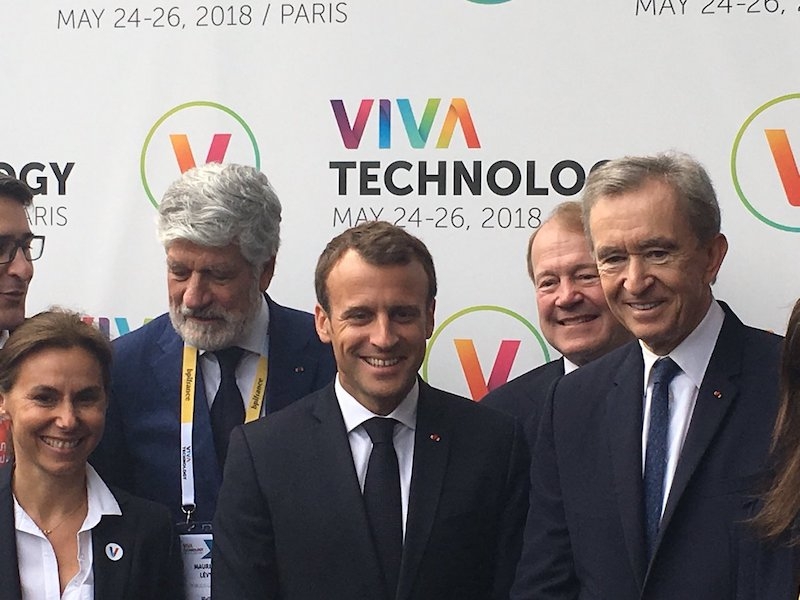
Maurice Levy & President Macron BernardArnault2018
(Source: X)
(Source: X)
VIVATECH AT 10: DESIGNING THE FUTURE OF TECH IN PARIS FROM MAURICE LEVY TO JEFF BEZOS, PRESIDENT MACRON AND GLOBAL AI LEADERS, FRANCE CLAIMS ITS TECH LEADERSHIP
In 2017, Emmanuel Macron just got elected, and huge defender of French TECH, formerly Minister of Economy and Finance (2016/2017). France counted barely three tech unicorns. Less than a decade later, by June 2026, the country now boasts 29, spanning AI, fintech, quantum, defence, greentech, health and consumer platforms. This acceleration has turned France into Europe’s most dynamic unicorn factory and one of the few ecosystems in the world able to structurally challenge the dominance of Silicon Valley and the major US and Asian hubs. While the United States still leads in absolute numbers, the gap is no longer infinite: France, together with a handful of European peers, has moved from the periphery of the digital economy to its centre of gravity, with VivaTech often serving as the annual stage where these new champions from Qonto and Mistral AI to Pasqal, Alan, Sorare or Dataiku meet global capital and regulators on home soil.
In 2017, Emmanuel Macron just got elected, and huge defender of French TECH, formerly Minister of Economy and Finance (2016/2017). France counted barely three tech unicorns. Less than a decade later, by June 2026, the country now boasts 29, spanning AI, fintech, quantum, defence, greentech, health and consumer platforms. This acceleration has turned France into Europe’s most dynamic unicorn factory and one of the few ecosystems in the world able to structurally challenge the dominance of Silicon Valley and the major US and Asian hubs. While the United States still leads in absolute numbers, the gap is no longer infinite: France, together with a handful of European peers, has moved from the periphery of the digital economy to its centre of gravity, with VivaTech often serving as the annual stage where these new champions from Qonto and Mistral AI to Pasqal, Alan, Sorare or Dataiku meet global capital and regulators on home soil.
EUROPE’S NEW TECH POWERHOUSE/ FRANCE OUTGROWS CES BY COMBINING INNOVATION, SOVEREIGNTY, INCLUSION AND GLOBAL SOUTH PARTNERSHIPS
Beyond the headline valuations, this shift owes much to a deliberate policy of tech sovereignty. Created in 2013, the Mission French Tech a public administration attached to the Ministry of Economy, Finance and Industrial and Digital Sovereignty, has systematically supported high?potential startups, structured a network of 125 French Tech Capitals and Communities across France and abroad, and coordinated more than 60 public “French Tech correspondents” in agencies such as Bpifrance, Business France or the Treasury. Its programs have backed 245 startups through national schemes, while, according to official figures, three out of five French citizens now use at least one French tech solution every month. This combination of branding (“La French Tech”), funding, regulatory support and international projection has given France something that few European countries can claim: an explicit state strategy to turn startups into global champions.
Beyond the headline valuations, this shift owes much to a deliberate policy of tech sovereignty. Created in 2013, the Mission French Tech a public administration attached to the Ministry of Economy, Finance and Industrial and Digital Sovereignty, has systematically supported high?potential startups, structured a network of 125 French Tech Capitals and Communities across France and abroad, and coordinated more than 60 public “French Tech correspondents” in agencies such as Bpifrance, Business France or the Treasury. Its programs have backed 245 startups through national schemes, while, according to official figures, three out of five French citizens now use at least one French tech solution every month. This combination of branding (“La French Tech”), funding, regulatory support and international projection has given France something that few European countries can claim: an explicit state strategy to turn startups into global champions.
FRANCE OUTGROWS CES BY COMBINING INNOVATION, SOVEREIGNTY, INCLUSION AND GLOBAL SOUTH PARTNERSHIPS In this landscape, emblematic stories matter. Alongside giants such as Qonto (neobanking), Mistral AI (open?source AI models), Pasqal (quantum computing), Morpho (DeFi), Pennylane (finance and accounting SaaS), Alan (digital health insurance) or Back Market and Vestiaire Collective (circular economy), it shows that France is no longer limited to a handful of consumer apps. For example, The Good Samaritan application, nominated by the World Summit Awards and valued at around 3 billion dollars by American investors, illustrates how French or Europe?based innovators can now attract serious global attention while remaining anchored in European norms and values such as Disability/Inclusion. It is building a diversified portfolio of unicorns and “centaurs” companies with over 100 million dollars in annual recurring revenue, that operate in critical sectors from defence (Harmattan AI) to cybersecurity and digital infrastructure.
Liability for this article lies with the author, who also holds the copyright. Editorial content from USPA may be quoted on other websites as long as the quote comprises no more than 5% of the entire text, is marked as such and the source is named (via hyperlink).