
Politics
FRANCE UNDER EXTREME HEAT ALERT: RECORD TEMPERATURES, INVISIBLE VICTIMS, LOW A.C
EVEN WITH PEAKS OF 43°C / 46°C
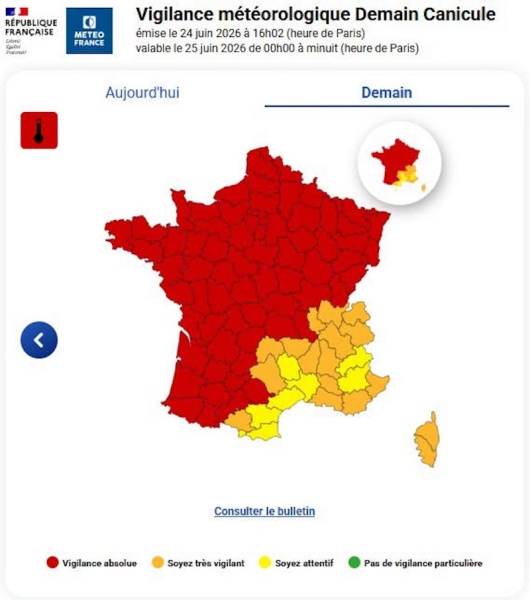
French map temperatures
(Source: Meteo France)
(Source: Meteo France)
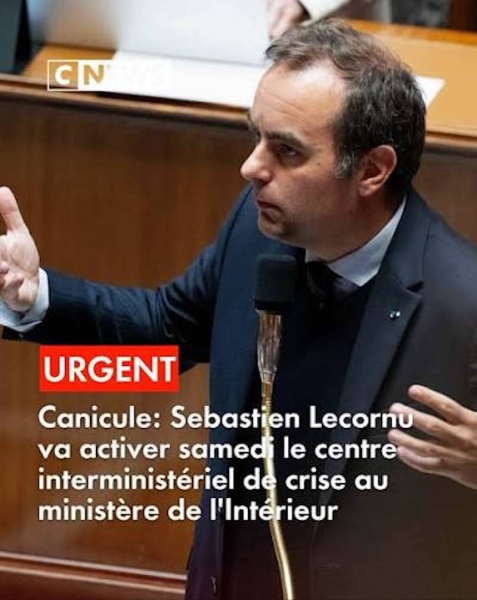
French Prime Minister Lecornu/ Heatwave
Source: French Government
Source: French Government
Our newsroom wishes to apologise to readers for not being able to provide official, consolidated figures on the number of deaths and victims linked to the ongoing heatwave in France. The Minister for Health, Families, Autonomy and Persons with Disabilities has indicated that national mortality data has not delivered none, and made it public , and no detailed, up?to?date breakdown has been released by the authorities to date.
In the absence of verified, granular figures from government or other official sources, it is therefore impossible for us, at the time of publication, to offer a precise and reliable death toll for this extreme weather episode. What we can report, however, is the reality on the ground: saturated hospitals, emergency services under sustained pressure, and a massive surge in calls to the medical emergency number (15) and to the fire and rescue services (18). This situation raises serious questions for people already in France, as well as for those who had planned to spend their summer holidays here, at a time when uncertainty over the duration and human cost of this heatwave remains very high.
In the absence of verified, granular figures from government or other official sources, it is therefore impossible for us, at the time of publication, to offer a precise and reliable death toll for this extreme weather episode. What we can report, however, is the reality on the ground: saturated hospitals, emergency services under sustained pressure, and a massive surge in calls to the medical emergency number (15) and to the fire and rescue services (18). This situation raises serious questions for people already in France, as well as for those who had planned to spend their summer holidays here, at a time when uncertainty over the duration and human cost of this heatwave remains very high.
DAY BY DAY ESCALATION
Since the beginning of the week, officials have repeatedly warned that “today is the hottest day so far, and the worst is yet to come”. Each day brings new records and the same messaging: this is exceptional, but under control. At the same time, the health system is already under visible strain.
Hospitals in the Paris region report saturated emergency departments, with a multiplication by four of patients linked to heat and a similar increase in emergency calls. Local authorities warn that the impact of heat is cumulative, with bodies collapsing after several days of sustained high temperatures.
Since the beginning of the week, officials have repeatedly warned that “today is the hottest day so far, and the worst is yet to come”. Each day brings new records and the same messaging: this is exceptional, but under control. At the same time, the health system is already under visible strain.
Hospitals in the Paris region report saturated emergency departments, with a multiplication by four of patients linked to heat and a similar increase in emergency calls. Local authorities warn that the impact of heat is cumulative, with bodies collapsing after several days of sustained high temperatures.
INFRASTRUCTURE STRESS AND ENERGY FAILURES, IN A COUNTY WITH ANTI A.C IDEOLOGY
On the infrastructure side, the picture is equally worrying. Around 270,000 households have lost electricity after overhead power lines, not buried, literally melted under the heat in some areas. One nuclear reactor is reportedly offline, raising further questions about the resilience of the energy system under extreme temperatures. In the Paris business district of La Defense, even large air?conditioning networks are failing: ice storage used to cool buildings cannot be replenished at night, and cinemas known for their “cool refuge” status warn that temperatures inside will be higher than usual. Most of Hospitals and even offices, are not the best equipped with air?conditioning in country where the Ecologists claimed this system of lowering temperatures is considered toxic and anti-Ecologist, in the name of a ideology, ended up the be the opposite of protecting human being Versus the machines.
On the infrastructure side, the picture is equally worrying. Around 270,000 households have lost electricity after overhead power lines, not buried, literally melted under the heat in some areas. One nuclear reactor is reportedly offline, raising further questions about the resilience of the energy system under extreme temperatures. In the Paris business district of La Defense, even large air?conditioning networks are failing: ice storage used to cool buildings cannot be replenished at night, and cinemas known for their “cool refuge” status warn that temperatures inside will be higher than usual. Most of Hospitals and even offices, are not the best equipped with air?conditioning in country where the Ecologists claimed this system of lowering temperatures is considered toxic and anti-Ecologist, in the name of a ideology, ended up the be the opposite of protecting human being Versus the machines.
Paradoxically, some sectors notably shopping malls and cinemas are seeing a sharp increase in footfall, as people seek artificial cool spaces to escape the heat. Box?office numbers are booming, with cinema attendance up by around 50% compared with the same week last year, turning the “dark rooms” into temporary climate shelters for those who can afford them. (Source Cnews TV)
A COUNTRY REPEATING THE MISTAKES OF 2003 DESPITE SOME DEPLOYED EFFORTS?
In 2003, France discovered the lethal combination of heat, social isolation and institutional unpreparedness, ending up with a catastrophic toll of 15, 000 death, mostly the elderly. The images of bodies left in morgues while families remained on holiday have left a deep and painful scar. Today, officials insist that “nothing is comparable” and that billions have been invested in hospitals and local adaptation. Yet the narrative of control clashes with the daily reality of emergency services under pressure, electricity failures, and public authorities apparently discovering, day after day, that the worst is still ahead.
In 2003, France discovered the lethal combination of heat, social isolation and institutional unpreparedness, ending up with a catastrophic toll of 15, 000 death, mostly the elderly. The images of bodies left in morgues while families remained on holiday have left a deep and painful scar. Today, officials insist that “nothing is comparable” and that billions have been invested in hospitals and local adaptation. Yet the narrative of control clashes with the daily reality of emergency services under pressure, electricity failures, and public authorities apparently discovering, day after day, that the worst is still ahead.
As the several Inter-Ministerial crisis meetings multiply under an unbearable temperature which is literally sparking nationwide, politicians and members of the Parliament and the government, seem to be speechless and stunned as well. It seems that the government wouldn’t take the risk to publish real?time mortality data, especially the most vulnerable people, and when people with disabilities are not even named in official discourse, and when homes turned into “energy sieves” become literal ovens, it is hard to talk about anticipation. What emerges instead is the sense of a country once again caught off?guard by a crisis that scientists, the IPCC and environmental actors have been announcing for decades, and that vulnerable citizens have already been living, summer after summer... To be continued.../
FESTIVAL OF MUSIC AND GAY PRIDE MARCH MAINTAINED DESPITE THE HEATWAVE
French authorities are signalling “record” heat and “general mobilisation”, yet remain strikingly silent on how many people have actually died in this heatwave, a contrast that feeds the sense of opacity and political nervousness. In parallel, major festive events like the Fête de la musique (21st of June) and the Paris Pride March (To be held on 27th of June) were maintained or only hesitantly questioned, as if the state were reluctant to assume the full consequences of its own alarmist rhetoric.

French Festival of Music 21 June 2026
Source: French Ministry of Culture
Source: French Ministry of Culture
Liability for this article lies with the author, who also holds the copyright. Editorial content from USPA may be quoted on other websites as long as the quote comprises no more than 5% of the entire text, is marked as such and the source is named (via hyperlink).