Politics
FRENCH MFA JN.BARROT, KALLAS DISCUSS MIDEAST SECURITY AND SUPPORT FOR UKRAINE
ON G7 SIDELINES
G7, Evian, France 2026 logo (Source: G7 France 2026)
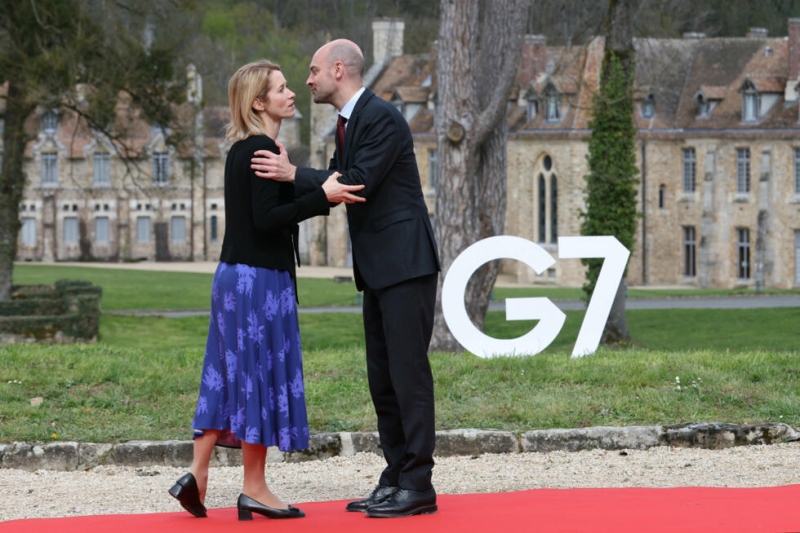
French MFA Jean Noel Barrot & UE Kaja Kallas
(Source: France 24 TV Caption)
(Source: France 24 TV Caption)
France’s Minister for Europe and Foreign Affairs Jean Noel Barrot met on 26 March 2026 with EU High Representative for Foreign Affairs and Security Policy Kaja Kallas, on the sidelines of the G7 foreign ministers’ meeting. The talks focused on the situation in the broader Middle East, its consequences for maritime security and freedom of navigation, and in particular the increasingly fragile situation in Lebanon. The two officials also reviewed the European Union’s support for Ukraine in the face of Russia’s ongoing aggression, with Mr Barrot reiterating France’s support for the swift adoption of a twentieth package of EU sanctions targeting Moscow and its so called “shadow fleet” designed to circumvent existing measures. (Source: French Ministry of Foreign Affairs
G7 UNDER FRENCH PRESIDENCY IN 2026, TO BE HELD IN EVIAN
This bilateral meeting takes place in a year when France holds the rotating presidency of the G7, twenty three years after the Evian G8 summit of 2003 and seven years after the Biarritz G7 hosted by President Macron in 2019. The Evian summit of heads of state and government, scheduled from 15 to 17 June 2026, will be at the centre of an international agenda marked by persistent geopolitical tensions, macroeconomic imbalances and growing financing needs for sustainable development and climate action. Paris wants to use this presidency to strengthen coordination of public policies, mobilise international financing and promote global public goods, while demonstrating the continued relevance of a “small format” forum such as the G7 in a more fragmented international system, alongside the US hosted G20 summit in Miami in December 2026
This bilateral meeting takes place in a year when France holds the rotating presidency of the G7, twenty three years after the Evian G8 summit of 2003 and seven years after the Biarritz G7 hosted by President Macron in 2019. The Evian summit of heads of state and government, scheduled from 15 to 17 June 2026, will be at the centre of an international agenda marked by persistent geopolitical tensions, macroeconomic imbalances and growing financing needs for sustainable development and climate action. Paris wants to use this presidency to strengthen coordination of public policies, mobilise international financing and promote global public goods, while demonstrating the continued relevance of a “small format” forum such as the G7 in a more fragmented international system, alongside the US hosted G20 summit in Miami in December 2026
LEBANON AND SECURITY IN THE EASTERN MEDITERRANEAN
Lebanon featured prominently in the Barrot–Kallas discussion, against the backdrop of overlapping political, economic and security crises. Both sides underlined the urgency of preserving Lebanon’s stability, supporting reforms and helping the country shield itself from regional spill overs, particularly along its borders and in its coastal waters. They stressed that safeguarding maritime routes in the Eastern Mediterranean is essential both for Lebanon’s own recovery and for wider regional trade and energy flows, at a time when attacks and incidents at sea are raising concerns over freedom of navigation
Lebanon featured prominently in the Barrot–Kallas discussion, against the backdrop of overlapping political, economic and security crises. Both sides underlined the urgency of preserving Lebanon’s stability, supporting reforms and helping the country shield itself from regional spill overs, particularly along its borders and in its coastal waters. They stressed that safeguarding maritime routes in the Eastern Mediterranean is essential both for Lebanon’s own recovery and for wider regional trade and energy flows, at a time when attacks and incidents at sea are raising concerns over freedom of navigation
UKRAINE, SANCTIONS AND THE RUSSIAN “SHADOW FLEET”
The two interlocutors also focused on the war in Ukraine and on the European Union’s long term support to Kyiv in the face of Russian aggression. Minister Jean Noel Barrot reaffirmed France’s backing for the rapid adoption of a twentieth EU sanctions package against Russia, aimed in particular at tightening restrictions on energy revenues and tackling the so called “shadow fleet” used to evade existing measures. Paris presented this stance as part of its broader effort, under its G7 presidency, to close loopholes in the sanctions regime and to align European and G7 partners on maritime enforcement.
The two interlocutors also focused on the war in Ukraine and on the European Union’s long term support to Kyiv in the face of Russian aggression. Minister Jean Noel Barrot reaffirmed France’s backing for the rapid adoption of a twentieth EU sanctions package against Russia, aimed in particular at tightening restrictions on energy revenues and tackling the so called “shadow fleet” used to evade existing measures. Paris presented this stance as part of its broader effort, under its G7 presidency, to close loopholes in the sanctions regime and to align European and G7 partners on maritime enforcement.
By meeting Kaja Kallas, EU’s MFA, on the margins of a G7 under French presidency, Jean Noël Barrot, Frenhc MFA sought to align Paris and Brussels on three strategic fronts: crisis management in the Middle East and Lebanon, safeguarding maritime security, and stepping up pressure on Russia while sustaining support for Ukraine. The exchange illustrates how France intends to use the 2026 G7 cycle not only as a forum for economic coordination, but also as a diplomatic lever to defend European interests and international law in an increasingly contested global environment. Source: French Ministry fo Foreign Affairs
Liability for this article lies with the author, who also holds the copyright. Editorial content from USPA may be quoted on other websites as long as the quote comprises no more than 5% of the entire text, is marked as such and the source is named (via hyperlink).